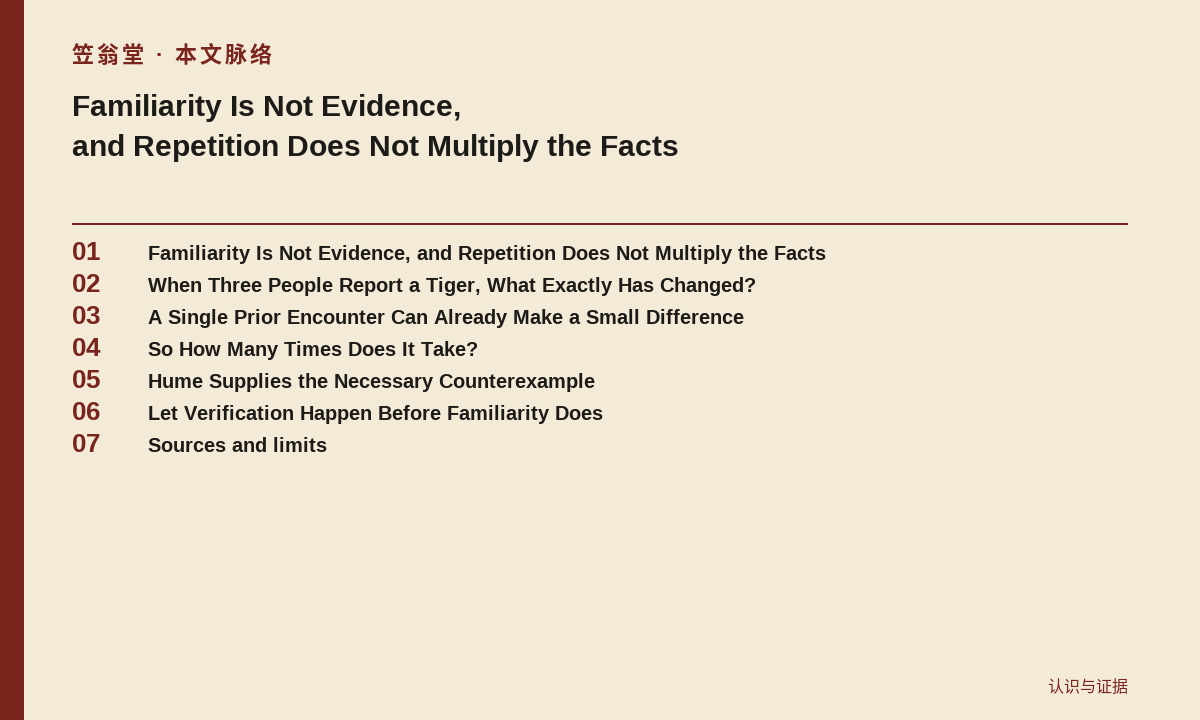
Familiarity Is Not Evidence, and Repetition Does Not Multiply the Facts
Imagine a company that hears the same market call five days in a row. It arrives first in a trade newsletter, then in a colleague’s retelling, then in

本文回答的问题
- If you have heard a claim many times, can you treat it as evidence?
- Does the old story of “three men make a tiger” show that repetition makes people believe?
- How many hearings does it take before a false claim starts to feel true?
- If a great many people share a message, does that count as confirmation from independent sources?
Familiarity Is Not Evidence, and Repetition Does Not Multiply the Facts
Imagine a company that hears the same market call five days in a row. It arrives first in a trade newsletter, then in a colleague’s retelling, then in a meeting packet, and later from two consultants. On paper, the claim has appeared five times. Follow the links back, and they may all lead to the same unchecked briefing. The voices around the table grow more aligned. The tree of evidence may still have only one branch.
Two different counts are easy to confuse. The exposure count records how many times a sentence has entered your field of view. The independent-evidence count records how many separate observations or tests support it. The first changes familiarity. Only the second can change the grounds you have for treating something as a fact. The central claim of this essay is: when the number of independent sources and the amount of testable content have not increased, further exposure may raise a proposition’s average truth rating without adding to its evidence. This is a rebuttable claim. If, once source independence, wording, and memory conditions are controlled, the repetition effect reliably disappears, the role of “repetition itself” should be narrowed. If new encounters come from genuinely independent tests, the evidence may grow with them.
When Three People Report a Tiger, What Exactly Has Changed?
In Strategies of the Warring States (Zhan Guo Ce), in the second section on the state of Wei, Pang Cong is about to accompany the crown prince to Handan. Before leaving, he asks the King of Wei: if one person says there is a tiger in the marketplace, will you believe it? What if two people say so? What if three? The answers move from “I would not believe it” to “I would.” Pang Cong’s point is that, once he is far from court, the people who will speak against him will number more than three, and he asks the king to look carefully. In the event, he is never received by the king again.
The story is sharp about how many mouths can change a political judgment. It does not, however, hand modern experiments a “rule of three.” Each time the story advances, the number of speakers and the number of hearings change together, and the listener knows he is facing different people. It cannot tell us what happens if the same source repeats a claim three times, or whether the three speakers have copied one another, or whether the king’s answer is a remark made on the spot or a stable belief. To read “three men make a tiger” as “a lie repeated three times will be believed” erases the part of the story most worth asking about: whether those voices were truly independent of one another.
Strategies of the Warring States is concerned with counsel, slander, and the political structure of what a ruler gets to hear. Who can keep reaching the center of power already shapes what comes to seem credible. Modern psychology experiments try to separate the stimulus, the interval, and the rating task, and ask how average judgments move when the same statement appears again. The two lines of work light up the same danger, but they do not sit at the same level of explanation. One reveals an asymmetry of power in who gets to speak. The other measures a familiarity effect under controlled conditions.
A Single Prior Encounter Can Already Make a Small Difference
In 1977, Lynn Hasher, David Goldstein, and Thomas Toppino asked participants to rate the validity of statements that mixed true and false items and looked, on their face, believable. Across three sessions spaced two weeks apart, ratings for repeated items rose with exposure; items that were not repeated did not show the same change. The study set up the experimental question later called the illusory truth effect: having seen a sentence before may make it seem truer later.
“Seem truer” has to be read narrowly. What the experiment found was a difference in average ratings on a scale. It did not directly observe whether people then placed a bet, shared the claim, made a purchase, or voted. A higher rating is also not the same as each person forming a firm belief. The study shows that a tendency in judgment can be measured. It does not, by itself, account for what happens once that tendency leaves the lab.
In 2015, Lisa Fazio and colleagues ran two experiments, each with 40 Duke undergraduates. Crossing repetition with prior knowledge that could be estimated, they found that repetition still raised average truth judgments even when a statement conflicted with knowledge the participants had available. That result is easily inflated into “knowledge is useless.” A more accurate reading is that the presence of knowledge does not guarantee it will be retrieved and used for checking in the moment. The sample is narrow, and the task is an experimental judgment. A higher mark on a scale is still some distance from accepting a whole story.
More realistic materials have shown a similar pattern. In 2018, Pennycook, Cannon, and Rand ran preregistered online experiments using true and false news headlines from the 2016 U.S. election, presented in a Facebook-like format. Across two experiments, with more than 1,800 people in total, a single prior exposure produced a small rise in the average accuracy rating of false headlines, with an effect of about d = .20–.21, still observable after about a week. Extremely implausible statements did not show the same repetition effect. The study shows that when the material is political news, familiarity can still take part in judgment. It does not show that repetition determines sharing, and it does not attribute an election result to this one experimental effect.
So How Many Times Does It Take?
There is no general scale for “after how many times it starts to sound like the truth.” In 2021, Aumyo Hassan and Sarah Barber directly manipulated repetition frequency. In Experiment 1, the final sample was 51 people, with prior presentations of 1, 3, 5, 7, or 9 times. In Experiment 2, the final sample was 57, with presentations of 1, 9, 18, or 27 times; a week later, old and new items were rated together. The largest jump occurred between never having seen a statement and having seen it once. Further repetition could still raise ratings, but the marginal gains diminished. Pairwise increments beyond nine times were not significant in that design. That can suggest an approach toward an asymptote; it cannot be used to announce a “cap at nine.” The materials were true trivia statements. The study did not use false statements, and it did not observe real-world actions.
A 2026 systematic review and meta-analysis by Steeven Ye and colleagues pulled the scale much wider: 99 articles, 182 studies, 366 effects, and a total sample of 31,184. The PEESE-adjusted average effect size was g = .37, 95% CI [.30, .44], with significant heterogeneity within and between studies. Of the 182 studies, only 43 were rated as low risk of bias, and 139 as raising “some concerns,” with signs of small-sample or publication asymmetry. The initial task, truth prompts, and type of material all moderated the results, and the effect for news headlines was smaller than for standard statements.
That overall picture is a long way from the claim that “once some number is reached, the mind gives in.” An average effect is there, but it is small, the conditions are many, and study quality is uneven. The geographic spread is especially unbalanced: among the studies reported in the review, 49 were from Europe, 47 from North America, and only 1 from Asia. We can talk about a tendency in judgment that recurs in the existing research. We do not have enough material to assert that the effect is the same size for Chinese-speaking audiences. Cultural difference is also not just a matter of swapping a Western sample for an Eastern one. How informational authority is formed, whether a retelling is treated as an independent source, and what it costs to correct a claim in public can all change how repetition is understood.
Hume Supplies the Necessary Counterexample
If the essay stopped here, it would be easy to slide into another lazy judgment: that whatever is repeated is suspect. When Hume, in Section V of An Enquiry Concerning Human Understanding, discusses inference from experience, he forces us to finish the sentence. Repeated observation of a constant conjunction between objects forms an expectation, through custom; the inference still has to start from a matter of fact in present sensation or memory. Hume is talking about inductive inference from experience, not forecasting twentieth-century experiments on illusory truth.
His account is the necessary counterexample. Astronomers independently observing the same body on different nights, laboratories separately preparing and measuring a material, physicians watching an effect in several independent samples: these “once mores” may genuinely add evidence. They add it not because the conclusion has grown familiar, but because the world has again been put to a testable question. By contrast, a hundred accounts sharing the same screenshot, or ten reports all pointing back to the same anonymous source, may multiply the nodes of circulation without adding an observation.
Independence also comes in degrees. It does not appear automatically because the institutional names differ. If two laboratories use the same contaminated samples, or three reports draw from the same gappy database, their errors can still move together. Conversely, the same team may provide substantially new information if, after preregistering its methods, it changes instruments, samples, and analysts and then replicates the work. So the evidence count also has to ask whether the ways of failing are shared. If several results would be brought down by one and the same error, they should not be counted as a full set of separate supports.
Strategies of the Warring States warns us to watch the order in which voices occupy a ruler’s ear. Hume helps us say how experience produces expectation. The two cannot be flattened into “the ancients had already discovered the repetition effect.” The first is focused on political counsel and its consequences; the second, on the epistemological problem of moving from experience to inference. Taken together, they make the boundary clearer: counting heads is not enough. You still have to ask whether each person has brought a new observation, or only the echo of an old claim.
Let Verification Happen Before Familiarity Does
Familiarity is not useless. Faced with a large volume of low-stakes information, no one can start from scratch every time. Fluency is often a cue that saves time. The danger appears when that cue is mistaken for the fact itself, especially once the same content has been retold through several layers and the interface has hidden its lineage.
Four experiments by Brashier, Eliseev, and Marsh in 2020 offer conditional evidence for an intervention. The analytic samples were 103, 99, 68, and 89 people. Asking participants, at first exposure, to judge accuracy rather than interest could eliminate the later illusory-truth pattern when relevant knowledge was present; the pattern was still seen after a two-day interval. This is not a prescription that works for every proposition and every platform. It does show that sequence matters: if, the first time you meet a sentence, you retrieve what you know and check it for accuracy, familiarity need not later bear the judgment on its own.
In ordinary life, verification can begin with one question: what observation does this appearance bring that was not there before? If the answer is only a change of speaker, headline, or layout, the evidence ledger should not gain a new mark. If it reports a new measurement, uses an independent sample, makes its methods available for checking, and leaves room for a negative result to appear, then the repetition begins to have the weight of Humean experience. Independence does not guarantee correctness, and several studies may still share a bias. But without independence, so-called confirmation from many sides has often not crossed the first door.
This distinction also marks the essay’s failure boundary. If a change in truth ratings does not travel onward into belief, sharing, or action, it has to stay at the level of ratings. A small average effect in the laboratory does not automatically explain the success or failure of propaganda, a purchase, or a political outcome. For claims whose source is clear, whose prior probability is extremely low, and that people actively check, the repetition effect may be weak or absent. Conversely, if future multi-laboratory studies, under comparable conditions, reliably find a null effect, or show that once memory for the source is controlled, repetition no longer plays an independent role, the claim this essay makes about familiarity will need to be revised.
We often abbreviate “many people are saying this” as “there is a lot of evidence,” because interfaces display the former more easily than the latter. But the circulation history of a message and the testing history of a proposition are two different ledgers. The unit of evidence is not the voice. It is the process of testing that produced the voice. How many times you have heard a sentence tells you how far it has traveled. How much independent evidence you have tells you how steadily it stands in the face of the facts.
Sources and limits
- Strategies of the Warring States (Zhan Guo Ce), “Wei Ce II,” “Pang Cong and the Crown Prince Held at Handan” (庞葱与太子质于邯郸), Chinese Text Project, URN
ctp:zhan-guo-ce/pang-cong-yu-tai-zi-zhi: https://ctext.org/zhan-guo-ce/pang-cong-yu-tai-zi-zhi/zh. The essay briefly quotes the exchange in that passage and offers the author’s reading. The narrative changes the number of people and the number of hearings at the same time, and cannot be used to identify a modern experimental effect or a “rule of three.” - David Hume, An Enquiry Concerning Human Understanding, Section V, §§36–38, reprinted from the 1777 posthumous edition, L. A. Selby-Bigge, 2nd ed. (1902), Project Gutenberg eBook #9662: https://www.gutenberg.org/cache/epub/9662/pg9662-images.html. The essay paraphrases Hume. He is discussing inductive inference and custom, not the mechanisms of the illusory truth effect.
- Lynn Hasher, David Goldstein & Thomas Toppino, “Frequency and the Conference of Referential Validity,” Journal of Verbal Learning and Verbal Behavior 16(1), 107–112 (1977): https://doi.org/10.1016/S0022-5371%2877%2980012-1. Supports only a change in average validity ratings in a particular task. This essay does not supply an unverified sample size, and does not extrapolate to behavior.
- Lisa K. Fazio, Nadia M. Brashier, B. Keith Payne & Elizabeth J. Marsh, “Knowledge Does Not Protect Against Illusory Truth,” Journal of Experimental Psychology: General 144(5), 993–1002 (2015): https://doi.org/10.1037/xge0000098; PubMed: https://pubmed.ncbi.nlm.nih.gov/26301795/. Two experiments, each with 40 Duke undergraduates. The conclusion is limited to the finding that knowledge did not automatically eliminate the effect in these tasks.
- Aumyo Hassan & Sarah J. Barber, “The effects of repetition frequency on the illusory truth effect,” Cognitive Research: Principles and Implications 6, 38 (2021): https://doi.org/10.1186/s41235-021-00301-5. The study used true trivia and measured ratings. Diminishing gains are not a cap at nine, and are not the same as everyone believing the claim.
- Gordon Pennycook, Tyrone D. Cannon & David G. Rand, “Prior exposure increases perceived accuracy of fake news,” Journal of Experimental Psychology: General 147(12), 1865–1880 (2018): https://doi.org/10.1037/xge0000465; materials and data: https://osf.io/txf46/. A controlled online experiment is not a causal study of a live platform. Accuracy ratings do not support conclusions about sharing, voting, or election results.
- Nadia M. Brashier, Emmaline Drew Eliseev & Elizabeth J. Marsh, “An initial accuracy focus prevents illusory truth,” Cognition 194, 104054 (2020): https://doi.org/10.1016/j.cognition.2019.104054; materials: https://osf.io/b4szp/. The intervention depends on relevant knowledge and on experimental conditions; it is not a general fix.
- Steeven Ye et al., “Systematic review and meta-analysis of the evidence for an illusory truth effect and its determinants,” Nature Communications 17, 3270 (2026): https://doi.org/10.1038/s41467-026-70041-x. The pooled results show heterogeneity, concerns about bias, and geographic skew. Evidence from Asia is scarce; this essay does not extrapolate an effect size for Chinese audiences.
常见问题
关于这篇文章的几个问题
答案来自本文论证,每条都可跳回对应小节核对。
If you have heard a claim many times, can you treat it as evidence?
No. The exposure count records how many times a sentence has entered your field of view; the independent-evidence count records how many separate observations or tests support it. The first changes familiarity; only the second can change the grounds for treating something as a fact. When the number of independent sources and the amount of testable content have not increased, further exposure may raise average truth ratings without adding to the evidence.
回到「Familiarity Is Not Evidence, and Repetition Does Not Multiply the Facts」小节 ↑Does the old story of “three men make a tiger” show that repetition makes people believe?
The story is sharp about how many mouths can change a political judgment, but in the narrative the number of speakers and the number of hearings change together, and the listener knows he is facing different people. It cannot tell us what happens if the same source repeats a claim three times. To read it as “a lie repeated three times will be believed” erases the part most worth asking about: whether those voices were truly independent of one another.
回到「When Three People Report a Tiger, What Exactly Has Changed?」小节 ↑How many hearings does it take before a false claim starts to feel true?
There is no general scale. Research finds that the largest jump occurs between never having seen a statement and having seen it once. Further repetition can still raise ratings, but the marginal gains diminish, and pairwise increments beyond nine times were not significant. That is not a basis for announcing a cap at nine. Meta-analysis finds an average effect, but it is small, the conditions are many, study quality is uneven, and the geographic spread is unbalanced.
回到「So How Many Times Does It Take?」小节 ↑If a great many people share a message, does that count as confirmation from independent sources?
No. A hundred accounts sharing the same screenshot, or ten reports all pointing back to the same anonymous source, may multiply the nodes of circulation without adding an observation. The unit of evidence is not the voice, but the process of testing that produced the voice. It also matters whether the ways of failing are shared. If several results would be brought down by one and the same error, they should not be counted as a full set of separate supports.
回到「Hume Supplies the Necessary Counterexample」小节 ↑继续读
沿着「认识与证据」这个主题
同一母题下的其他文章,可以接着读。

在知识地图上标出未知
“我不知道”不是知识的失败,而是知识地图上的边界线。没有这条线,人会把听过当成懂得,把术语当成解释,把一次成功当成稳定能力。
阅读全文
个案入场,统计重新称重
1981 年 6 月,美国 CDC 的《发病率与死亡率周报》记录了洛杉矶三家医院发现的五例罕见 Pneumocystis pneumonia(PCP)。五例太少,无法估计患病率,更没有单独证明后来确认的病因与传播机制。它们仍然重要:此前健康的年轻人集中出现罕见疾病,说明既有监测图景漏掉了某种异常,值
阅读全文
善意解释,也要随证据转身
面对含混言行,先选择能够维持合作的合理解释,是一种认识纪律;但在清楚证据反复出现后仍替对方开脱,就从善意变成自我欺骗。
阅读全文